
A training plan should not require three calculators and a small crisis before you leave the house. Most of the sessions in this hub use time and plain-language effort. Race distances stay exact, and the difference between those two things is made visible.
Three measures, three jobs
Time tells you how long the appointment lasts. Distance tells you how much ground you cover. Effort tells you how demanding the activity feels today. A useful log includes all three, plus relevant context such as hills, heat, walking and stops.
None is a complete measure of training stress. Forty minutes on a level path and forty minutes of steep downhill running can look identical in a calendar while being very different experiences. Nor does a slower pace automatically mean that the effort was easy.
Our effort language
Easy running is conversational, usually around 2 to 4 on an informal 0 to 10 effort scale. Steady work is more purposeful, around 5. Controlled threshold-style work is roughly 6 to 7. Faster intervals may reach 7 to 8 during the repetitions. None of these descriptions asks you to sprint at maximum effort.
These are editorial cues, not individually measured thresholds. The talk test has research support as a practical intensity guide, but it is not a precise laboratory assessment and is less useful for very short, hard repetitions.[1] Combine the words with honest observation. Easy running should not require an argument with the watch.
Do not map these numbers automatically to a wearable's heart-rate zones. Zone systems differ, and a label such as “zone 2” can refer to different intensity boundaries in three-zone and five-zone models.[2] We deliberately avoid generating personalised heart-rate zones from age or a generic maximum-heart-rate formula.
Why thirty minutes does not always mean 5K
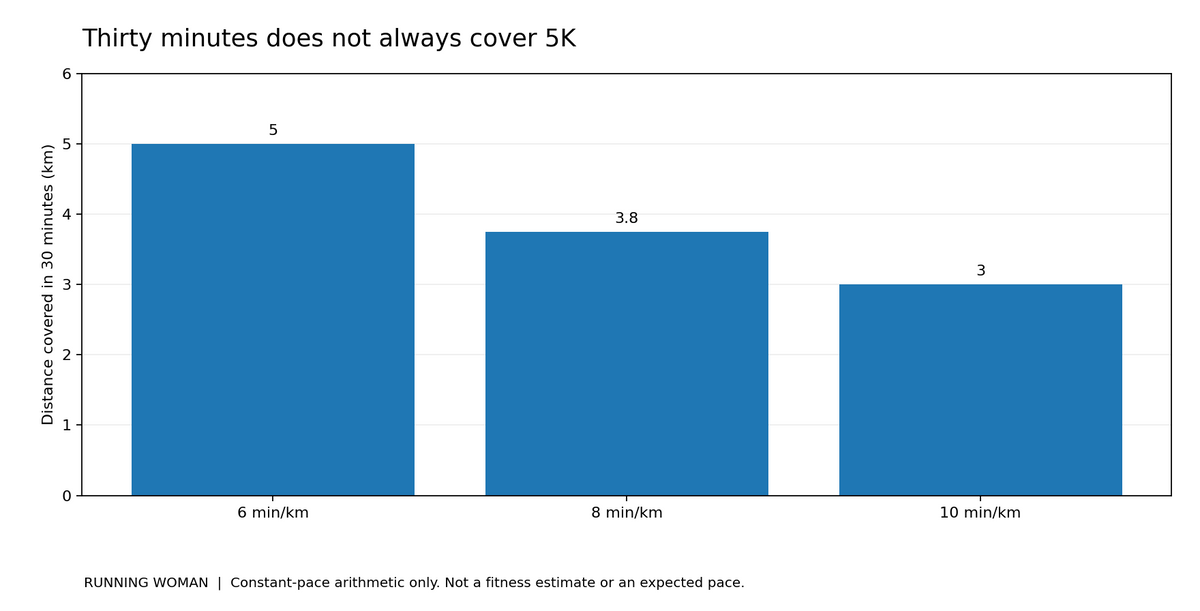
Distance equals time divided by pace. At 6 min/km, thirty minutes covers 5 km. At 8 min/km, it covers 3.75 km. At 10 min/km, it covers 3 km. All three outings can be valid training.
The NHS programme's final-week running portions are thirty minutes.[3] Its title should not be used to promise that every participant will cover 5K in that time. Our completion plans therefore allow walking and use actual distance review points before an event.
A conversion tool can explain arithmetic. It cannot establish readiness. Covering three kilometres today does not tell an algorithm that you can safely cover five tomorrow at the same pace.
Count the whole workout
A session of six two-minute repetitions contains twelve minutes of faster running, but that is not its complete duration. Preparation, recoveries and the finish also belong in the diary.
For example, 12 minutes easy, 5 × 2 minutes controlled with 2 minutes easy between repetitions, then 10 minutes easy totals 40 minutes: 12 + 10 + 8 + 10. There are four recoveries, not five, because recovery is between repetitions.
Walking recoveries still take time. For run-walk sessions, five minutes walking before and after are also counted. The hub labels these as elapsed session minutes rather than presenting every minute as running.
A time cap is not a distance target in disguise
The long-outing caps in our templates are workload-design choices. They are not universal safe limits, and no reader should run faster to squeeze a target distance inside one.
A slower runner may need a different plan because the capped outings do not provide enough distance exposure for the intended event. This is especially important for the marathon and longer trail events. The correct response is a route-specific review, a longer preparation period or individual coaching, not silently stretching the final long run.
Observational half- and marathon research can inform that conversation, but does not provide a single mandatory longest-run distance for everyone.[4]
Current pace is more useful than dream pace
For a performance goal, use recent relevant efforts as context, not a future time you would love to run. The short interval session should stay repeatable, and a steady marathon-rhythm session should not become threshold work because the target pace is too ambitious.
Recent race results are also conditional. Weather, surface, fatigue, course accuracy and how hard you raced all matter. A downhill 5K or a social event does not give the same information as a well-paced, representative effort.
Our plans do not calculate a promised marathon time from a 5K result. The goal-setting guide explains how to use performance information without making it a guarantee.
Elapsed time matters for events
A watch's moving-time pace can exclude toilet stops, aid stations, navigation pauses and traffic crossings. Event cut-offs generally relate to an organiser-defined timing system, which must be checked directly.
For illustration, a 10K covered in 80 minutes of movement plus 10 minutes stopped has an elapsed time of 90 minutes, not 80. The pace calculation must use the relevant clock. Do not hide the stops simply because they make the prediction less flattering.
A useful minimum log
After a session, note total time, approximate distance, overall effort and any unusual symptoms. For long outings, add food, drink, terrain and how the following day felt. Avoid turning every easy run into a data review meeting.
Use patterns to ask questions. When easy effort repeatedly requires much slower running, recovery feels unusually difficult or symptoms persist, the next step is not automatically more training. Adjust the plan and seek appropriate help where needed. The watch supplies observations; it does not overrule your experience.
Sources and further reading
-
Reed JL, Pipe AL (2014). The talk test: a useful tool for prescribing and monitoring exercise intensity. Current Opinion in Cardiology. DOI: 10.1097/HCO.0000000000000097. ↩︎
-
Stöggl TL, Sperlich B (2015). The training intensity distribution among well-trained and elite endurance athletes. Frontiers in Physiology. DOI: 10.3389/fphys.2015.00295. ↩︎
-
NHS (accessed 2026-10-03). Get running with Couch to 5K. NHS. ↩︎
-
Fokkema T et al. (2020). Training for a (half-)marathon: Training volume and longest endurance run related to performance and running injuries. Scandinavian Journal of Medicine & Science in Sports. DOI: 10.1111/sms.13725. ↩︎