
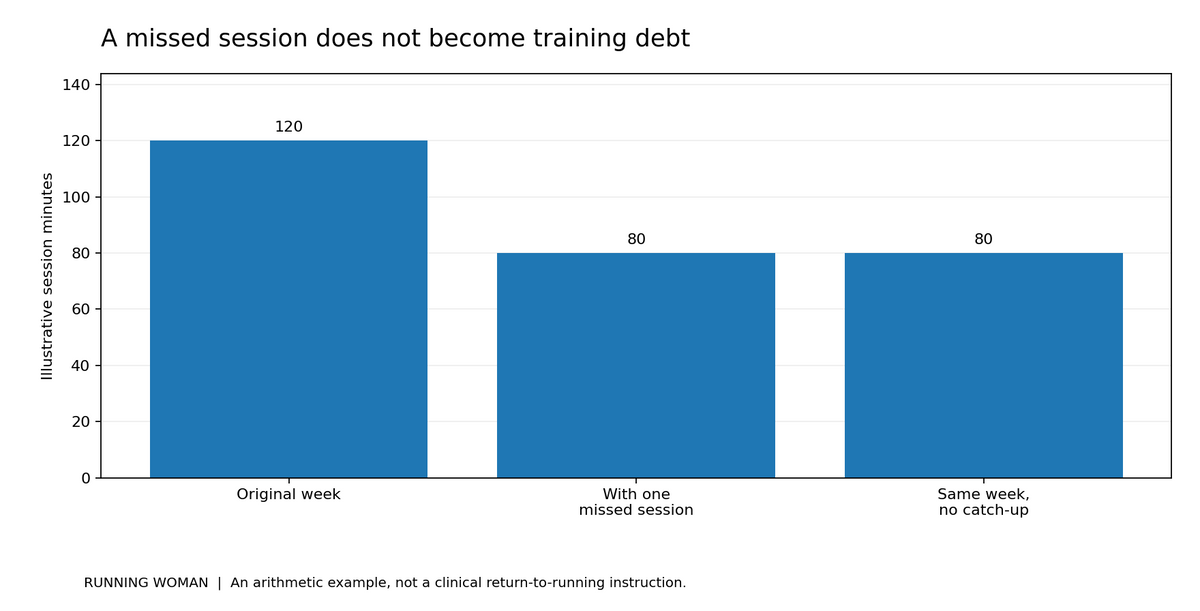
A training plan is a proposed sequence, not a debt ledger. Missing a run does not create minutes you must repay, and two missed weeks cannot be recovered by making the remaining weeks twice as hard.
The most useful adjustment preserves the purpose of the plan while respecting the reason it changed.
One missed easy run
Usually, leave it missed. Resume the next appropriate session rather than adding distance to several later runs. A single gap is not a reason to rewrite the entire programme or test your fitness.
When the next session is demanding and you feel tired, stressed or out of rhythm, make that one easy too. This is our conservative template rule, not a universal research-derived percentage adjustment.
A missed workout or long run
Do not move it into the nearest empty box without considering what surrounds it. A Sunday long run moved to Monday can crowd Tuesday's workout. A hard club session added on Friday can change the meaning of Saturday and Sunday.
Choose between omitting the session, moving the whole sequence with appropriate recovery, or repeating a suitable week. The busiest solution is not automatically the most effective one. The original weekly table has no privileged status when the circumstances have changed.
Several missed days or weeks
The relevant question is what you have been able to do and why, not just the number of calendar days. A holiday with comfortable walking differs from an illness with fever. A stressful work week with poor sleep differs from a planned short break.
After a substantial interruption, compare your present routine with the plan's entry checks. Begin with comfortable activity and reassess before restoring long or hard sessions. A coach may help choose where to restart. Do not resume at week nine simply because the calendar now says week nine.
Research on maintaining performance under reduced training concerns particular populations and protocols; it should not be turned into a guarantee that every runner retains race readiness after time away.[1]
Illness is not a scheduling inconvenience
The IOC respiratory-illness consensus treats return to sport as a graded, symptom- and risk-based process, not a single fixed day. Moderate or severe illness warrants clinical involvement.[2]
Do not train through fever, significant systemic illness or concerning chest/breathing symptoms to protect a race date. Resume cautiously after recovery, and seek medical advice for persistent symptoms, unusual exercise intolerance or uncertainty after a significant illness. A simplistic “above or below the neck” rule is not an adequate clearance system.
For tight or squeezing chest pain, severe breathing difficulty or an unresponsive collapse, seek emergency help. In the UK, call 999 for those emergency signs.[3] A training-plan page is not the right place to diagnose them.
Pain changes the decision
Stop when pain changes how you run, rather than changing your stride to finish a prescribed number. Persistent focal pain, pain with ordinary walking or recurring symptoms need appropriate assessment. Do not use painkillers as a way to satisfy the table.
Our return-to-running template is explicitly not injury rehabilitation. Its title should never be used to bypass an individual return plan from a clinician or physiotherapist. Existing treatment advice takes precedence over a generic schedule.
Weather: keep the purpose, change the setting
In uncomfortable or unsafe conditions, choose a safer time, a suitable indoor option, a shorter easy outing or rest. Do not chase the same pace simply because the plan was written for a calm day.
A treadmill session can preserve time and effort for some road-running sessions, but it does not recreate every demand of an outdoor trail event. Do not pretend that a flat indoor long run proves competence on remote or technical terrain. The trail guide explains the separate skills involved.
For ice, storms, flooding, poor visibility or extreme weather, cancellation is a training decision, not a character flaw. Follow current local warnings and event instructions rather than relying on a static article for conditions.
Travel and family weeks
Plan likely interruptions before starting the block. A busy week can become a consolidation or cutback week rather than an ambitious peak week performed badly.
Pack the minimum routine that fits the situation: perhaps a few shorter easy outings rather than a long run in an unfamiliar place. Do not create a “holiday catch-up week” afterwards. The plan may need extending, and the race goal may need changing.
Sleep is a legitimate part of this decision. Athlete sleep guidance emphasises individual needs and the wider sleep environment rather than one perfect number for everyone.[4] Repeatedly sacrificing sleep to protect a training streak is not a neutral trade-off.
A practical restart sequence
First, resolve the reason for stopping or obtain appropriate advice. Next, try a manageable easy session without a pace test. Observe the response during the session and afterwards. Restore routine before long duration or harder intensity, changing one major demand at a time where possible.
This is an editorial framework, not a rehabilitation protocol. Any symptoms or individual medical advice can alter it. After significant lost preparation, a later event or a different distance may be the right outcome.
Permission to change the goal
You can arrive at race week and decide not to race. You can use a run-walk approach where the event permits it. You can choose a shorter distance or another date, subject to the organiser's current rules.
The objective is not a perfect row of ticks. It is to support a sustainable relationship with running. A good plan leaves room for the person following it.
Sources and further reading
-
Spiering BA, Mujika I, Sharp MA, Foulis SA (2021). Maintaining Physical Performance: The Minimal Dose of Exercise Needed to Preserve Endurance and Strength Over Time. Journal of Strength and Conditioning Research. DOI: 10.1519/JSC.0000000000003964. ↩︎
-
Schwellnus M et al. (2022). International Olympic Committee (IOC) consensus statement on acute respiratory illness in athletes part 1: acute respiratory infections. British Journal of Sports Medicine. DOI: 10.1136/bjsports-2022-105759. ↩︎
-
NHS (accessed 2026-10-03). Heart attack. NHS. ↩︎
-
Walsh NP et al. (2021). Sleep and the athlete: narrative review and 2021 expert consensus recommendations. British Journal of Sports Medicine. DOI: 10.1136/bjsports-2020-102025. ↩︎