
Six weeks, twelve weeks, twenty weeks: the number on a plan looks reassuringly precise. Unfortunately, the calendar does not know whether you have been running for six years or six days.
Preparation time should be considered alongside your starting base, intended distance, available weekly training and recovery. Our durations are useful editorial structures, not experimentally established deadlines by which every runner adapts.
Count the training before the plan
A twelve-week marathon-specific block may sit on top of months or years of consistent running. Calling it a twelve-week programme does not make it a twelve-week route from inactivity to a marathon.
Research comparing published marathon plans makes this distinction especially important. Knopp and colleagues analysed the final twelve weeks of 92 plans whose complete durations ranged from twelve to thirty weeks. The study described the prescriptions; it did not test their effectiveness in runners.[1]
A second study linked the training histories of 917 Boston Marathon finishers to performance, including information from the year before the race.[2] It was observational and drawn from a selected marathon population. It supports considering the wider preparation history, not copying those athletes' workloads into a first-run plan.
What a longer calendar buys you
A longer route can provide time to establish frequency, extend the long outing, practise kit and food, and repeat a week when life intrudes. It also makes it easier to separate changes rather than adding distance, intensity and training days together.
Those are design opportunities, not guaranteed benefits. A runner can still overreach during a twenty-four-week plan, and a long calendar can become exhausting when every week is treated as a test. Build in periods that consolidate rather than escalate.
Our longest beginner 5K route has smaller early running portions and more space to remain with walking breaks. The twenty-four-week marathon route starts from an established running base and uses the extra weeks for progressive endurance and rehearsal. They are not the same idea scaled by distance.
What a shorter calendar requires
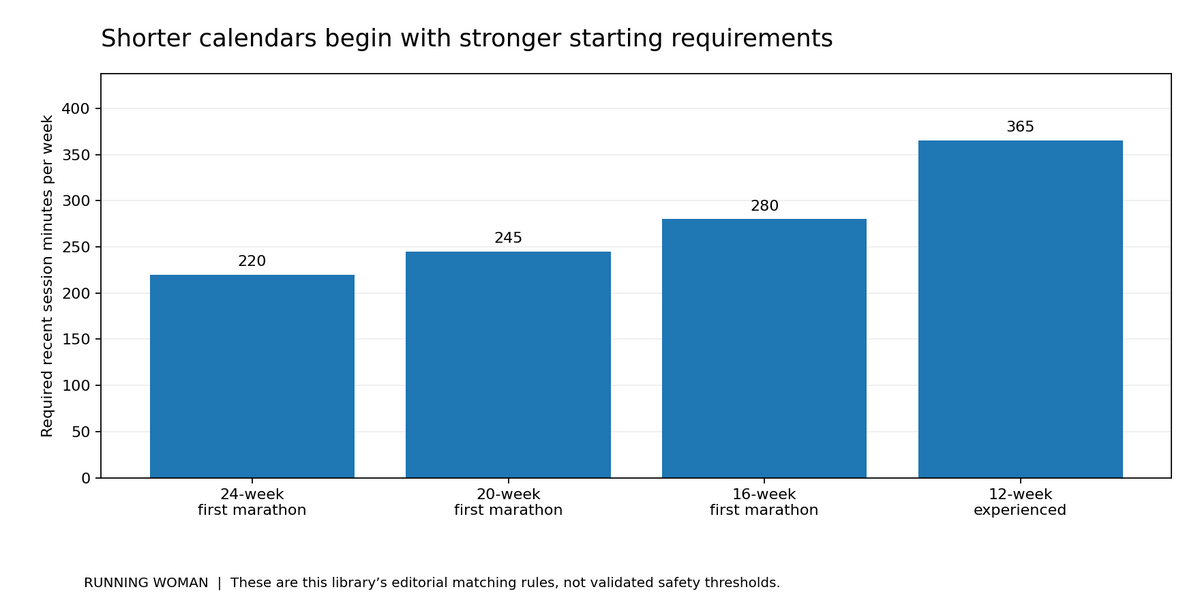
Short routes require more of the preparation to be present already. That is why the six-week 5K sharpening plan and eight-week half-marathon block have stronger entry checks than first-distance plans.
Missing prerequisites cannot be repaired by deleting rest days. A smaller number of calendar weeks does not justify larger jumps, two workouts in one day or skipping the taper. The useful alternative may be a shorter event, a completion rather than performance goal, or a later date.
There is no eight-week first-marathon-from-inactivity plan in this library.
The available routes in this hub
| Goal | Available calendars | What changes between them |
|---|---|---|
| Foundation | 4, 6, 8 weeks | Walking, return after a life break, or consolidation of an existing running base |
| One mile | 6, 8 weeks | First run-walk finish versus improvement from an established base |
| 5K | 6, 8, 12, 16 weeks | Gentle introduction, first distance, improver or already-trained sharpening |
| 10K | 8, 12, 16 weeks | Existing run-walk/5K base, first 10K or performance work |
| 10 miles | 8, 12 weeks | First distance versus improvement |
| Half marathon | 8, 12, 16, 20 weeks | Progressively stronger starting requirements for shorter routes |
| Marathon | 12, 16, 20, 24 weeks | A sustained base is required throughout; twelve weeks is a final specific block |
| Trail 10K / half | 12 / 16 weeks | Existing running plus terrain familiarisation |
| Trail 50K | 16, 24 weeks | Previous ultra experience versus first 50K from marathon experience |
These are catalogue descriptions, not claims about the minimum safe time to train.
Leave space between now and week one
When you have more time than the selected plan needs, keep the extra weeks before the race-specific block. Use comfortable existing training, a foundation route or an individual consolidation period. Do not begin halfway through a longer plan just to fill the gap, and do not repeat peak long-run weeks until race day arrives.
The first week of a plan is not necessarily the next Monday. It is the first complete week that both fits your readiness and lines up with the event.
A date can fit while the training does not
Suppose there are sixteen weeks before a marathon, but your current longest comfortable outing is thirty minutes. The sixteen-week first-marathon template would not match that starting point. A matching calendar alone is not enough.
Conversely, someone with a substantial long-run base may choose a shorter specific block without being reckless solely because it is short. Readiness and recovery still need review. The calendar is one input, not the verdict.
Does slower progression prevent injury?
A randomised trial comparing a thirteen-week graded novice programme with an eight-week standard programme did not find a reduction in running injuries from the graded programme.[3] That does not prove that all progression rates are equally sensible. It does mean that “longer” or “the 10% rule” should not be advertised as an injury-prevention guarantee.
Our approach is to expose the starting requirements, keep changes visible, include cutbacks and encourage repeated review. The progression guide explains the uncertainty around load measures in more detail.
When the deadline is immovable
Keep the event date, but allow the goal to change. That might mean a shorter distance offered by the organiser, a deliberately comfortable run-walk event within the rules, spectating this time or transferring the entry where permitted. Verify the event's current options directly.
Training is not a moral contract with a registration confirmation. The plan should help you arrive prepared enough to make a good decision, including the decision not to start.
Sources and further reading
-
Knopp M, Appelhans D, Schönfelder M, Seiler S, Wackerhage H (2024). Quantitative Analysis of 92 12-Week Sub-elite Marathon Training Plans. Sports Medicine - Open. DOI: 10.1186/s40798-024-00717-5. ↩︎
-
DeJong Lempke AF et al. (2026). Training Volume and Training Frequency Changes Associated with Boston Marathon Race Performance. Sports Medicine. DOI: 10.1007/s40279-025-02304-4. ↩︎
-
Buist I, Bredeweg SW, van Mechelen W, Lemmink KAPM, Pepping GJ, Diercks RL (2008). No effect of a graded training program on the number of running-related injuries in novice runners: a randomized controlled trial. American Journal of Sports Medicine. DOI: 10.1177/0363546507307505. ↩︎