
A long-run plan that tells you when to run but never when to practise eating leaves out an important part of preparation. Food, drink and the practical business of carrying them should be rehearsed before the event.
This guide provides general education, not an individual nutrition prescription. Medical conditions, allergies, gastrointestinal problems and a history of disordered eating may require a registered sports dietitian or other appropriate clinician.
Start with ordinary meals
The foundations are enough overall food and a routine that supports the training you are actually doing. A short easy outing does not need to become a technical feeding exercise, and increasing training should not be paired automatically with trying to lose weight.
The joint sports-nutrition position statement emphasises matching nutrition to the demands of training and performance.[1] Leave room for a familiar meal or snack around longer outings, and do not schedule them in a way that repeatedly makes eating difficult.
You do not have to earn breakfast. Nor does completing a prescribed number of minutes prove that your energy intake was adequate. The women's-health guide explains why persistent symptoms and low energy availability deserve attention.[2]
Carbohydrate during longer exercise
Burke and colleagues describe carbohydrate intake scaled to the event: around 30 to 60 grams per hour for longer exercise, with intakes up to about 90 grams per hour potentially useful for events lasting more than two and a half hours, using appropriate carbohydrate combinations.[3]
These are general sports-nutrition ranges, not a command to start at the highest number. Intensity, duration, tolerance and the specific event matter. A beginner should not copy an elite runner's intake without practice, and this article does not prescribe a compulsory hourly intake for every short easy run.
For a practical rehearsal, choose one familiar source, check the carbohydrate amount on the label and practise it during a suitable longer outing. Increase complexity or intake gradually with individual guidance when needed. Record what you consumed and how your stomach felt, not just the target you hoped to reach.
An arithmetic example, not a recommendation
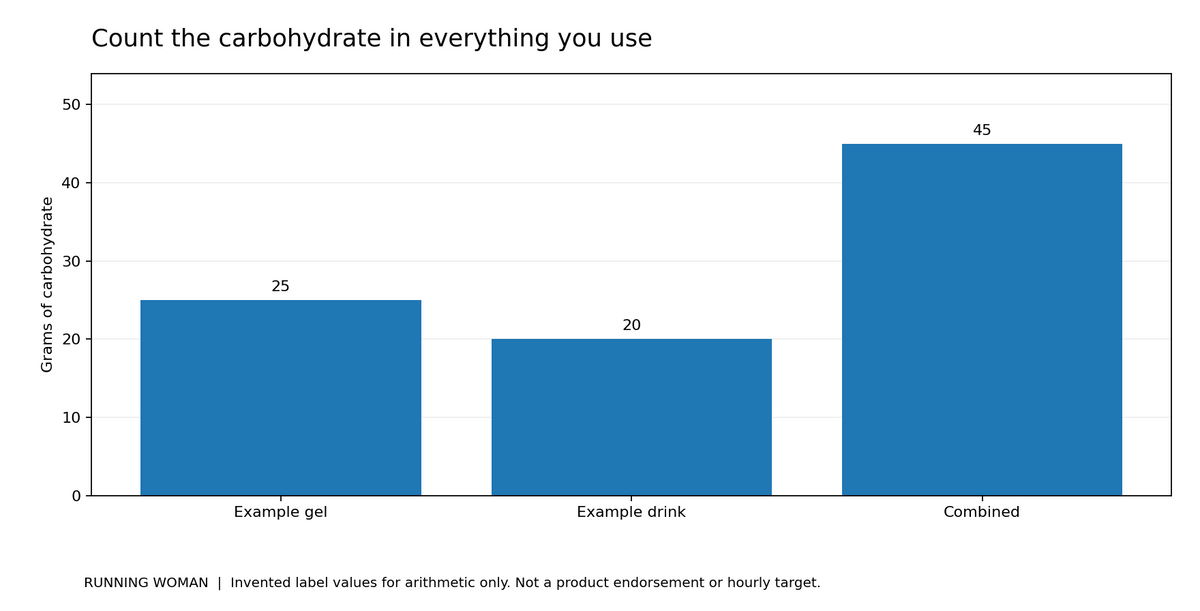
Suppose a runner has already established that 45 grams per hour suits a particular two-hour outing. The total would be 90 grams. A gel containing 25 grams and a drink containing 20 grams of carbohydrate would contribute 45 grams together; count both rather than treating the drink as calorie-free water.
Those product amounts are hypothetical examples. They are not product recommendations or claims about a specific brand. The point is to count actual carbohydrate, test the combination and avoid discovering on race day that the plan was based on the wrong serving size.
Why ultra fuelling can be different
The ISSN ultra-marathon position stand stresses individualisation, food variety, tolerance and progressive gut practice. Its recommendations reflect the different demands of very prolonged events.[4]
Do not assume that the upper carbohydrate range used in some endurance racing is compulsory throughout a much longer ultra, or that one road-marathon gel strategy will remain pleasant for many hours. Rehearse available foods, the gaps between aid stations and how you will carry what you need.
Our 50K plans include these rehearsals as tasks, not as an optional shopping list. They do not specify a personalised calorie requirement or recommend restrictive diets, ketones or supplements as shortcuts.
Hydration without forced drinking
Fluid needs vary with the person, conditions and activity. Avoid drinking large amounts simply to meet an arbitrary target. The exercise-associated hyponatraemia review identifies overdrinking as an important concern and supports thirst-guided intake as a practical prevention approach.[5]
That is not a reason to leave fluids unavailable on a remote outing. Plan access, carry enough for the route and conditions, and practise an individual strategy. Do not turn either “drink to thirst” or a generic millilitres-per-hour range into a rigid rule that overrides circumstances or medical advice.
Sodium does not make excessive fluid intake harmless.[5:1] A salt product is not insurance against overdrinking, and a training plan should not prescribe universal salt doses without assessing the context.
Before, during and after
Before a key outing, use familiar food and leave an amount of time that you know your stomach tolerates. During longer work, practise the strategy relevant to your event. Afterwards, arrange normal meals and fluids rather than letting the day disappear into errands.
Those habits can be planned in the diary even when they are not counted as running minutes. A long run that ends five minutes before a demanding work shift may need a different start time or a different day.
A useful rehearsal log
Record the outing duration, approximate distance, conditions, what you ate or drank, the approximate timing and any symptoms. Include toilet or aid-station stops in elapsed time. Note whether the carrying system was comfortable and whether packaging was manageable while moving.
Change one major variable at a time where possible. A new breakfast, new gel, new drink and harder pace in the same outing make it difficult to learn what worked.
Race-week restraint
Do not debut a dramatically different diet or a large new intake during the taper. A carbohydrate-loading strategy for a long event needs individual planning; it is not simply eating an unlimited amount at one evening meal.
Check the organiser's current food and drink provision directly and carry a workable alternative when necessary. Sponsorship can change, portions can differ and your own tolerance remains the deciding factor.
The goal is not to become a full-time nutrition accountant. It is to remove avoidable surprises so that your running preparation has something reliable to run on.
Sources and further reading
-
Thomas DT, Erdman KA, Burke LM (2016). American College of Sports Medicine Joint Position Statement. Nutrition and Athletic Performance. Medicine & Science in Sports & Exercise. DOI: 10.1249/MSS.0000000000000852. ↩︎
-
Mountjoy M et al. (2023). 2023 International Olympic Committee’s (IOC) consensus statement on Relative Energy Deficiency in Sport (REDs). British Journal of Sports Medicine. DOI: 10.1136/bjsports-2023-106994. ↩︎
-
Burke LM, Hawley JA, Wong SHS, Jeukendrup AE (2011). Carbohydrates for training and competition. Journal of Sports Sciences. DOI: 10.1080/02640414.2011.585473. ↩︎
-
Tiller NB et al. (2019). International Society of Sports Nutrition Position Stand: nutritional considerations for single-stage ultra-marathon training and racing. Journal of the International Society of Sports Nutrition. DOI: 10.1186/s12970-019-0312-9. ↩︎
-
Hew-Butler T, Loi V, Pani A, Rosner MH (2017). Exercise-Associated Hyponatremia: 2017 Update. Frontiers in Medicine. DOI: 10.3389/fmed.2017.00021. ↩︎ ↩︎