
A goal can make training feel purposeful. It can also become an unhelpful promise when a plan title implies that completing the table guarantees a particular finish time.
This hub separates completion, improvement and sharpening. It does not sell a sub-thirty-minute 5K or sub-four-hour marathon as an outcome a calendar can guarantee.
A first finish is a complete goal
For a first distance, preparation can focus on manageable training, comfortable longer outings, sensible pacing and practical event skills. There is no requirement to set a time target in order for the training to count.
A run-walk approach is compatible with a completion goal. In a small randomised marathon study, the run-walk group reported less muscle discomfort and fatigue, while the finishing-time difference was not statistically significant.[1] That does not prove equivalent performance for everyone or reduced cardiac stress. It also does not validate our particular ratios or promise an easier marathon.
Choose the strategy because you have rehearsed it and it fits the event, not because it is marketed as a guaranteed shortcut.
Improvement can mean more than speed
A runner may aim to avoid starting too hard, manage hills more calmly, tolerate their planned food, finish with fewer unplanned stops or recover more comfortably from the training routine. These goals can be observed without turning every run into a race.
A time goal can sit alongside them, but should not erase them. A well-executed run in difficult conditions may reflect progress even when the clock does not.
Use recent, relevant evidence
A recent representative race can help frame a target. So can a sequence of controlled sessions that were genuinely repeatable. Consider the course, conditions, effort and how you recovered, rather than taking the fastest number from any setting.
A 5K result says something about 5K performance. It does not establish marathon endurance, fuelling tolerance or the ability to manage a much longer event. Training history is part of the picture, not an optional adjustment to a prediction formula.[2]
A race-time conversion is not an entry test. Read each plan's starting requirements alongside your recent training and relevant experience.
Why race-equivalence tools need careful labels
A calculator can estimate a relationship under assumptions, but a predicted number is not a prescription or a guarantee. Different distances draw on different aspects of preparation, and extrapolating a short effort to a marathon can be especially misleading when the endurance base is missing.
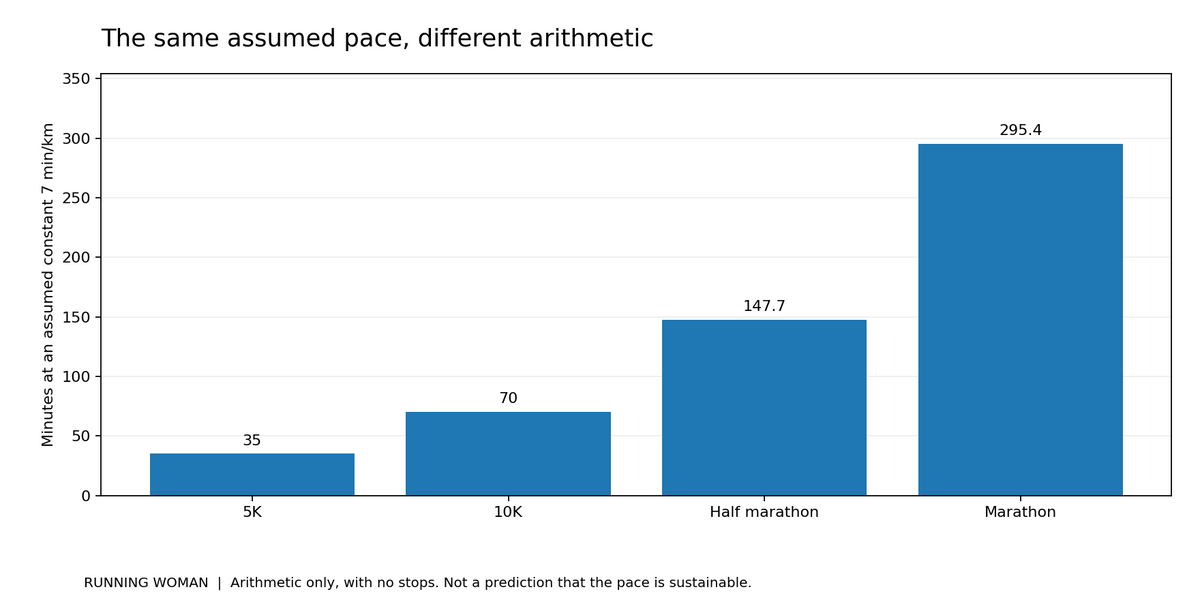
For example, 42.195 km at 7 min/km gives 295.365 minutes, or approximately 4 hours 55 minutes 22 seconds, before adding any time not included in that pace. That calculation does not demonstrate that a particular runner can sustain it.
Set a process goal beside the outcome
A practical completion goal might be: begin with the rehearsed easy strategy, use planned walking breaks and review effort rather than chasing people nearby. An improver might aim to keep the early pace controlled and execute the practised fuelling plan.
These are illustrative examples. Choose a small number of observable behaviours that are appropriate to the event and your experience.
The purpose is not to remove ambition. It is to give ambition something controllable to work with.
Do not train at the target all the time
A desired race pace is not the correct pace for every session. Easy running stays easy. Controlled faster work is paced for the session's purpose and your current capacity.
Observational marathon data show that faster groups often accumulated more easy training, but cannot prove that copying their pattern causes improvement.[3] A small recreational-runner trial comparing intensity distributions also should not be inflated into a universal 80/20 rule.[4]
Our templates use mostly easy activity with limited purposeful faster work where the starting experience supports it. The exact proportions are editorial choices, not a claim that every session has been physiologically classified from the calendar.
Goal reviews belong before the final week
Revisit the goal after a meaningful stretch of consistent training and again before tapering. Consider missed preparation, symptoms, conditions, the actual long outings and the event's rules. Adjusting a goal early is more useful than attempting a last-minute fitness test.
A rehearsal event can replace a workout when planned appropriately. It should not be added to a week already containing the full prescription. The cost of racing matters even when the event is described as practice.
Give race day more than one acceptable outcome
An appropriate decision to slow down, walk or stop can be a good decision even when it ends a time goal. Health and current conditions take precedence over a plan written months earlier.
Afterwards, review the preparation and execution without turning the result into a personal ranking. A finish line can help you understand your running; it does not have to become an exam you might fail.
Sources and further reading
-
Hottenrott K, Ludyga S, Schulze S, Gronwald T, Jäger F-S (2016). Does a run/walk strategy decrease cardiac stress during a marathon in non-elite runners?. Journal of Science and Medicine in Sport. DOI: 10.1016/j.jsams.2014.11.010. ↩︎
-
Fokkema T et al. (2020). Training for a (half-)marathon: Training volume and longest endurance run related to performance and running injuries. Scandinavian Journal of Medicine & Science in Sports. DOI: 10.1111/sms.13725. ↩︎
-
Muniz-Pumares D, Hunter B, Meyler S, Maunder E, Smyth B (2025). The Training Intensity Distribution of Marathon Runners Across Performance Levels. Sports Medicine. DOI: 10.1007/s40279-024-02137-7. ↩︎
-
Muñoz I, Seiler S, Bautista J, España J, Larumbe E, Esteve-Lanao J (2014). Does polarized training improve performance in recreational runners?. International Journal of Sports Physiology and Performance. DOI: 10.1123/ijspp.2012-0350. ↩︎