
A fast runner can be new to structured training. A slower runner can have years of endurance experience. Neither observation is a contradiction, and neither person needs a label that makes them feel small.
For this hub, ability is primarily a description of the training you can currently sustain. Race pace is useful for some sessions, but it does not decide your worth or automatically tell us how many days you should run.
New to running
This group needs a routine that introduces running itself. Our walking foundation and first-mile or first-5K run-walk routes focus on manageable outings and repeatability. They do not assume a comfortable continuous 5K, previous intervals or a long run at the weekend.
Starting with walking may be appropriate when even the first run-walk week would be a substantial jump. That is a different starting point, not an embarrassing one. The walking foundation ends with walking readiness; it does not secretly promise that everyone will run thirty minutes by week four.
The NHS offers a well-established public run-walk route for people starting out, while allowing a progression that is not about speed.[1] Our alternatives are original calendars with different starting checks and are not copies or official extensions of that programme.
Returning after a break
Previous running experience helps you recognise sensations and routines. It does not prove that your current capacity equals your old capacity.
The six-week return route is for a life or diary interruption in somebody already comfortable with the opening run-walk sessions. It is not a return-from-injury programme. A break caused by significant illness, an operation, childbirth or persistent pain needs the appropriate assessment rather than an automatic “returning runner” label.
Consider how much training remained during the break. A person who continued short easy runs is in a different position from somebody who stopped completely. The same old personal best can belong to both people. Consider your recent training rather than your best result from years ago.
Established, but new to the distance
This is the most easily misunderstood category. An established runner may be entering a first 10K, half marathon or marathon. The new element is the event distance, not the habit of running.
Our first-half plans ask for a sustained routine and existing long-outing experience. The first-marathon plans ask for more. A longer calendar makes room to build from that base; it does not remove the base requirement.
An observational study of half- and full-marathon runners linked training volume and longest runs with performance, but cannot supply a universal entry test or prove that more is always better.[2] We therefore use transparent editorial thresholds for matching and label them as such, rather than presenting one mileage number as a scientific dividing line.
Improver
An improver already has a comfortable relationship with the distance and wants to develop some aspect of the race. That might be even pacing, confidence on hills, fewer unplanned stops, a better final third or a faster finish.
Controlled faster workouts belong here only when the surrounding easy routine is stable. Our improver templates usually contain one primary faster session, with the long outing remaining easy. This is a deliberate design choice, not a claim that every runner needs exactly one workout.
A weekly hard parkrun counts as a demanding session. It cannot be added to the table while still describing the programme as one-workout-per-week training. The useful question is what it replaces.
Experienced or performance-focused
In this library, experienced means established consistency, familiarity with purposeful workouts and the ability to accommodate the plan's volume and frequency. It does not mean professional or elite.
Performance templates may use five or six days and more easy running. They are not trophies. A runner choosing a four-day plan because it fits their recovery and family life has made a training decision, not accepted a lower rank.
Elite training research can illuminate principles but should not be used to transplant elite mileage into recreational lives.[3] We keep that distinction explicit. The plans here are recreational templates, not elite programmes with the numbers reduced by an arbitrary percentage.
Why age and sex do not generate a level
We do not move a runner down a category on a birthday, or prescribe a fixed mileage reduction because she is a woman. Nor do we assume that women need gentler ambitions. Current training, symptoms, recovery, health history and practical constraints are more useful inputs to this hub.
The evidence has limitations. The recent running-economy strength review included fewer women than men, for example, so it should not be dressed up as precise knowledge of every woman's ideal training dose.[4] The correct response is transparent uncertainty and individual adjustment, not an invented female-specific formula.
A practical self-check
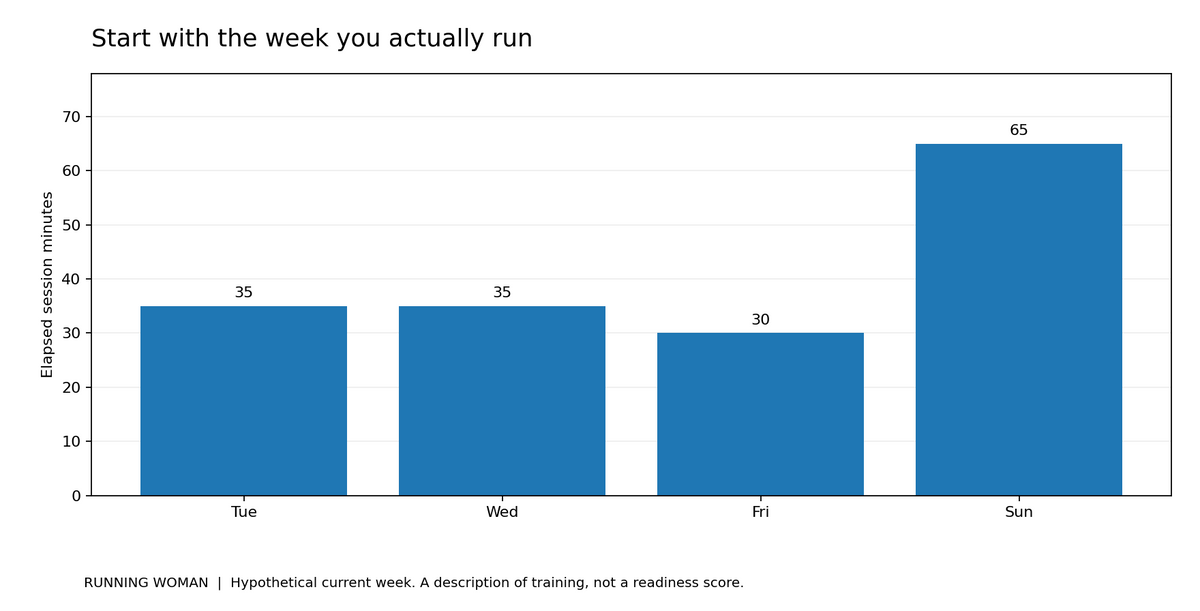
Read the prospective plan's week one aloud: days, minutes, longest outing and any workout. Then compare it with a routine you actually completed repeatedly. Next, read the peak week. Finally, ask whether the plan requires experience you do not yet have, such as a previous marathon or trail navigation.
Choose a lower-load or longer route when those checks do not fit. A mismatch is information. It is not a failed assessment, and it is not fixed by choosing a different ability label.
Keep the label flexible. You can be experienced at 5K and new to trail running, an established run-walker preparing for a first marathon, or a previously fast runner rebuilding gently. Your history is more interesting than one word on a plan card.
Sources and further reading
-
NHS (accessed 2026-10-03). Get running with Couch to 5K. NHS. ↩︎
-
Fokkema T et al. (2020). Training for a (half-)marathon: Training volume and longest endurance run related to performance and running injuries. Scandinavian Journal of Medicine & Science in Sports. DOI: 10.1111/sms.13725. ↩︎
-
Haugen T, Sandbakk Ø, Seiler S, Tønnessen E (2022). The Training Characteristics of World-Class Distance Runners: An Integration of Scientific Literature and Results-Proven Practice. Sports Medicine – Open. DOI: 10.1186/s40798-022-00438-7. ↩︎
-
Llanos-Lagos C, Ramirez-Campillo R, Moran J, Sáez de Villarreal E (2024). Effect of Strength Training Programs in Middle- and Long-Distance Runners’ Economy at Different Running Speeds: A Systematic Review with Meta-analysis. Sports Medicine. DOI: 10.1007/s40279-023-01978-y. ↩︎