
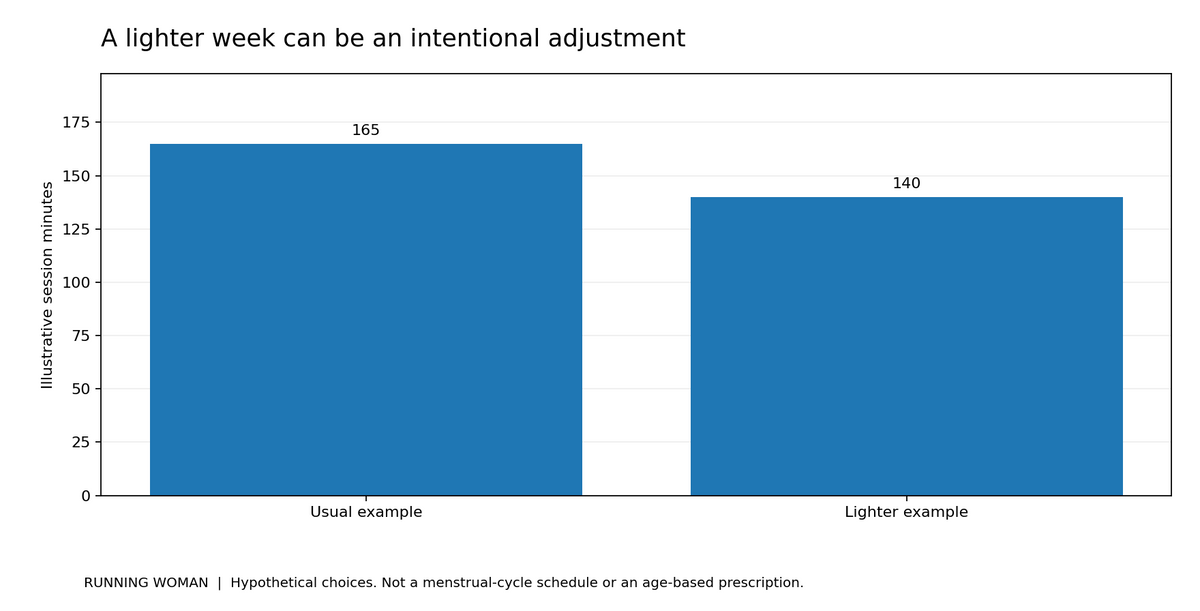
These templates are intended for adults choosing general recreational running goals. They are not pregnancy plans, postpartum rehabilitation, treatment for menstrual or pelvic-floor symptoms, or a medical screening service.
Menstrual symptoms deserve attention
Some runners notice little change across a cycle. Others experience pain, heavy bleeding, fatigue or other symptoms that alter what feels manageable. A useful log can record symptoms and how training feels, without assuming that a calendar phase dictates the outcome.
McNulty and colleagues' systematic review found small average effects and substantial limitations in the evidence. The authors wrote that “general guidelines on exercise performance across the MC cannot be formed”.[1] MC means menstrual cycle. That finding does not dismiss individual symptoms; it cautions against one-size-fits-all cycle-based prescriptions.
Our practical approach is symptom-led. Keep the intended session when it feels appropriate, reduce or move it when needed, and seek assessment for symptoms that are persistent, severe or disruptive. Do not automatically place every hard workout in one calendar phase or insist that a difficult day must be hormonal.
Hormonal contraception and irregular cycles
The cited menstrual-cycle review is not a universal account of every contraceptive method, irregular cycle, perimenopause or clinical condition. A period date alone should not determine your training week.
You do not need to share private cycle information to use a general training plan.
Enough energy is part of preparation
The IOC consensus on Relative Energy Deficiency in Sport describes health and performance consequences associated with problematic low energy availability.[2] REDs cannot be diagnosed from one symptom, a watch score or a website quiz.
Persistent fatigue, recurrent bone-stress problems or menstrual disruption should not be celebrated as proof of commitment. They warrant appropriate assessment. Do not assume a missing period is simply a normal consequence of running, and do not make the training plan a weight-loss challenge.
Our templates include fuelling practice and do not prescribe calorie deficits or “earning” food through mileage. A registered sports dietitian can help when training demands, appetite, gastrointestinal problems or medical conditions make eating difficult.
Pregnancy
The NHS advises introducing new exercise gently and indicates that familiar activity can often continue during pregnancy, with appropriate precautions and advice.[3] That does not make an existing race-build schedule automatically suitable throughout pregnancy.
Speak with the maternity team about individual circumstances and symptoms. Avoid using the hub's ability label, a previous race result or a generic readiness score as clearance.
Returning after childbirth
The 2025 Canadian postpartum activity guideline concerns physical activity, sedentary behaviour and sleep across the first postpartum year; it is not a blanket clearance date for running.[4]
A 2026 co-designed postpartum return-to-running guide provides a further practical framework, but its development study does not demonstrate that following the guide prevents injury or guarantees a safe return.[5] We do not convert it into a “start running at week X” instruction.
Symptoms, healing, prior activity, birth experience, pelvic-floor function and practical recovery support need individual consideration. Leakage, heaviness, pelvic pain or other concerns deserve appropriate assessment, often with a pelvic-health physiotherapist. Our six-week return plan is not labelled postpartum and should not be repurposed as one.
Perimenopause and menopause
The NHS describes symptoms that can include sleep problems, hot flushes and changes in periods.[6] Their effect on an individual training week varies. A runner may need to adjust recovery or timing without abandoning meaningful goals.
There is no automatic mileage discount in this hub for reaching a particular age or life stage. Equally, symptoms should not be ignored because a plan used to work. Track what changes, discuss disruptive symptoms with a healthcare professional and adjust the routine on the basis of the person, not an assumed decline.
This article does not advise on hormone treatment or supplements. Those decisions require a separate clinical conversation, not an affiliate link beside a training table.
Strength, ageing and recovery
Strength-training research in runners can inform support work, but many studies have limited representation across sex, age and life stages.[7] We therefore avoid claiming that one small routine is an optimal prescription for every woman over forty or every postpartum runner.
The practical aim is a familiar, progressive routine appropriate to current capacity. The optional twenty-minute slots in the plans are starting structures, not age-specific therapeutic programmes. A qualified professional can adapt movements, loading and frequency when needed.
When to stop and seek help
Concerning exercise symptoms should not be explained away as poor fitness or hormones. Tight or squeezing chest pain, severe breathing difficulty or unresponsive collapse require emergency help; call 999 in the UK for those signs.[8]
For persistent pain, unusual fatigue, heavy or disruptive bleeding, recurrent injury or pelvic-floor symptoms, arrange appropriate non-emergency assessment. A plan can wait while the cause is understood.
The supportive message is not that women need less ambition. It is that ambition and attention to health belong together, and a generic calendar must leave space for both.
Sources and further reading
-
McNulty KL et al. (2020). The Effects of Menstrual Cycle Phase on Exercise Performance in Eumenorrheic Women: A Systematic Review and Meta-Analysis. Sports Medicine. DOI: 10.1007/s40279-020-01319-3. ↩︎
-
Mountjoy M et al. (2023). 2023 International Olympic Committee’s (IOC) consensus statement on Relative Energy Deficiency in Sport (REDs). British Journal of Sports Medicine. DOI: 10.1136/bjsports-2023-106994. ↩︎
-
NHS (accessed 2026-10-03). Exercise in pregnancy. NHS. ↩︎
-
Davenport MH et al. (2025). 2025 Canadian guideline for physical activity, sedentary behaviour and sleep throughout the first year post partum. British Journal of Sports Medicine. DOI: 10.1136/bjsports-2025-109785. ↩︎
-
James ML et al. (2026). An interdisciplinary, co-designed guide for return to running postpartum: a mixed-methods study. Frontiers in Sports and Active Living. DOI: 10.3389/fspor.2026.1771882. ↩︎
-
NHS (accessed 2026-10-03). Symptoms of menopause and perimenopause. NHS. ↩︎
-
Llanos-Lagos C, Ramirez-Campillo R, Moran J, Sáez de Villarreal E (2024). Effect of Strength Training Programs in Middle- and Long-Distance Runners’ Economy at Different Running Speeds: A Systematic Review with Meta-analysis. Sports Medicine. DOI: 10.1007/s40279-023-01978-y. ↩︎
-
NHS (accessed 2026-10-03). Heart attack. NHS. ↩︎

